

The main difference between digital AI and physical AI lies in how the intelligence interacts with the world: the former operates exclusively within software and data, while the latter acts directly in the material world through a physical body.
According to data from the International Federation of Robotics (IFR), there are about 174 manufacturers and companies worldwide working on humanoid robotics.
China clearly leads the sector, hosting more than half of the manufacturers; the United States ranks second with leading companies such as Tesla, Boston Dynamics, Figure AI, and Apptronik.
At the core of both digital AI and physical AI lies the exact same matrix: computational mathematics, data processing, and Machine Learning algorithms, specifically Deep Learning.
The transition from hydraulics to electrics is the true industrial and engineering revolution shaping the new generation of humanoid robots. For decades, hydraulics was the only solution to grant robots nearly “superhuman” strength, but today electric motors have closed the gap, offering previously unthinkable advantages.
Hydraulic pumps must remain constantly active to maintain pressure, consuming a significant amount of energy even at rest. Conversely, electric actuators consume energy almost exclusively when the robot is moving. As a result, batteries last much longer.
The robot can perform non-human movements, such as twisting its torso without moving its feet, which reduces the required maneuvering space.
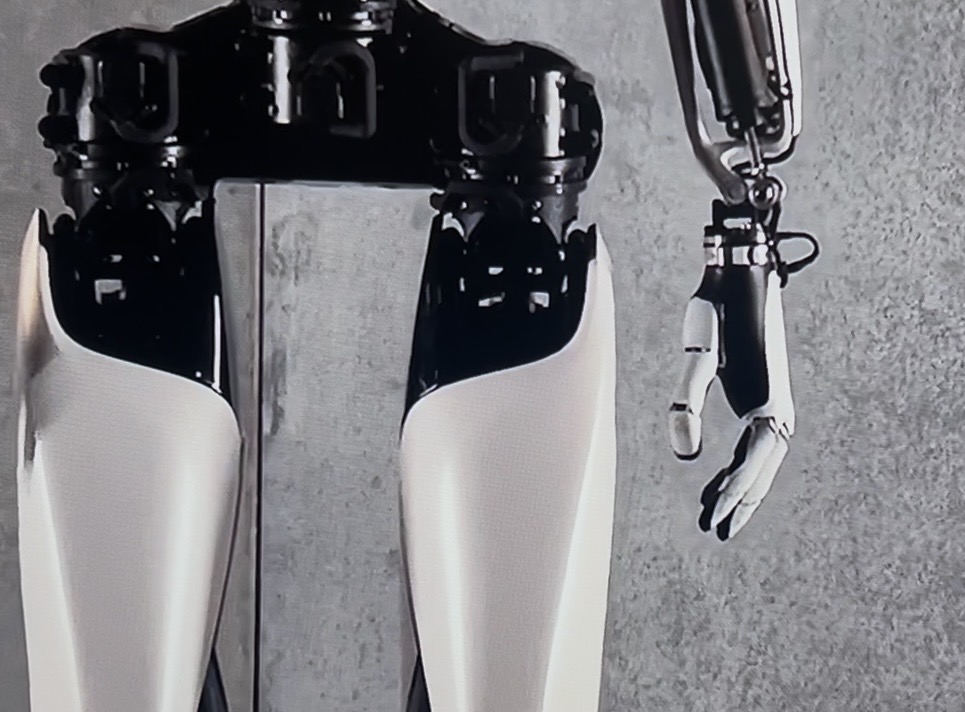
If you look at the legs or arms of Tesla’s Optimus, you can see cylinders that resemble hydraulic pistons; in reality, these are electromechanical linear actuators. No high-pressure oil flows inside them; instead, they feature a planetary roller screw.
An electric motor spins this internal screw at very high speeds, translating rotary motion into a highly powerful linear thrust. This architecture allows Optimus to achieve an immense lifting force of up to 8,000 Newtons per actuator while remaining entirely electric. To connect these linear actuators to the skeletal structure—for instance, at the knees, elbows, and ankles—Tesla extensively utilizes uniball spherical joints (rod ends).
Tesla has patented a knee system based on a four-bar linkage that mimics human ligaments. To allow the leg to achieve a smooth rotation of up to 150 degrees using a single electric “piston,” the anchor points must be able to move freely across multiple axes: the uniball is the perfect, extremely lightweight mechanical solution.
Having engineered cars for years, Tesla possesses a massive supply chain and deep know-how regarding the spherical joints used in the suspension and steering arms of vehicles like the Model 3 or Model Y. Scaling that technology down to robots was a natural step to drive down industrial costs.
The earliest concepts were developed on the German Messerschmitt fighter aircraft. The United States military command tasked the Heim Company of Fairfield, Connecticut, led by Lewis R. Heim, with copying and improving that concept. From that moment on, in English-speaking countries, this joint took on the official name of “Heim Joint”.
Colin Chapman, the founder of Lotus, realized that to make the early double-wishbone suspensions and arms of open-wheel race cars work effectively, the old, heavy rubber bushings or threaded pins were inadequate. Uniballs allowed mechanics to adjust toe, camber, and ride height down to the millimeter simply by turning the threaded body of the joint. By the mid-1960s, no top-tier race car (F1, Can-Am, Le Mans prototypes) could do without uniballs in its suspension systems.